


What does it mean to invest in the S&P 500?
The S&P 500 is a well-known stock market index. An index isn't an investment itself, but a list of companies that are related in some way or otherwise grouped together.
Contrary to popular belief, the stocks that form the index are not the 500 largest U.S. companies. However, they are arguably among the most important. The S&P 500 is one of the stock market indexes people may use to gauge the health of the overall U.S. stock market.
You can't directly invest in the S&P 500 index, but you can invest in a fund — such as an index fund or exchange-traded fund (ETF) — that tracks the index. So rather than purchasing 500 individual company stocks listed in the S&P 500, you can purchase an S&P 500 fund that contains all of them at the same time.
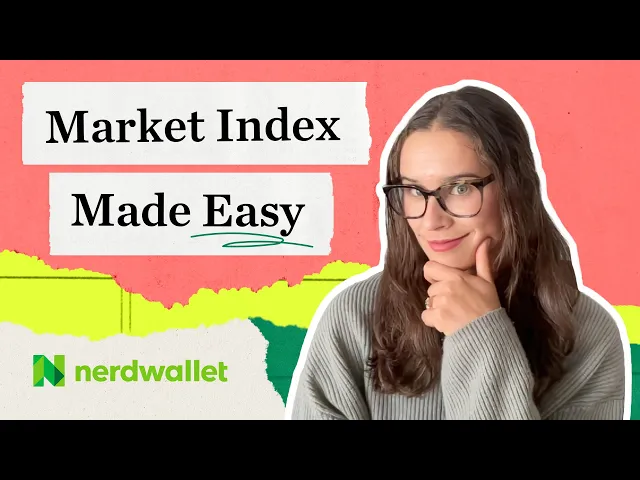
Watch our rundown of all things S&P 500 →
Alana Benson, a senior writer at NerdWallet, discusses the S&P 500's historical performance, the market caps of the stocks it holds and more.

06:19
The easiest way to invest in the S&P 500
An S&P 500 index fund or ETF is the simplest way to invest in the index. These funds aim to replicate the S&P 500's returns. Over the last century, the S&P 500 has returned about 10% per year on average, before inflation. (Tip: Use our investment calculator to see what compound returns could do for your money.)
Investing in an S&P 500 fund can offer instant diversification and is generally less risky than buying single stocks directly. Because the fund tracks the performance of the S&P 500, when that index does well, your investment will, too. The opposite is also true, of course.
To purchase S&P 500 index funds or ETFs, you'll need to open a brokerage account first. You can invest through a standard taxable brokerage account or a retirement-focused account, such as an IRA. From there, you can narrow down which fund to choose by looking at expense ratios and minimum investments.
When you've landed on which fund to buy, depending on where you opened your account, you may be able to choose a number of shares to purchase or pick a specific dollar amount to invest. After you've placed your order, you may want to check in on your investment periodically to make sure its performance is similar to that of the S&P 500 index.
Prefer a visual walk-through?
In this video guide, NerdWallet editor Bella Avila demonstrates how to invest in an S&P 500 ETF using a self-managed brokerage account.

This is not financial advice, nor is this a recommendation of VOO, Fidelity, or any investments or strategies discussed in this video. Content is for demonstration purposes only.
How much does it cost to invest in the S&P 500?
If you are investing in an S&P 500 index fund:
- If your index fund has no minimum, you can usually purchase in any dollar amount. If your index fund has a minimum, you have to purchase at least that amount.
- If your index fund has an expense ratio, you'll be charged that as a fee. An expense ratio is an annual fee expressed as a percentage of your investment. For example, if you invest $100 and your fund has an expense ratio of 0.04%, you'll pay an annual fee of $0.04.
If you are investing in an S&P 500 ETF:
- ETFs trade similarly to stocks and have a share price. You'll either need to pay the full share price or find a broker that offers fractional shares, which let you invest in any dollar amount.
- Similar to index funds, ETFs often have expense ratios, so make sure you see how much you'd be paying in fees to invest in a given ETF.
If you are investing in a stock within the S&P 500 index:
- Stock costs vary significantly. Some stocks in the S&P 500 cost under $100, and others cost $500 a share or more. Be sure to check each stock's share price before you decide to buy or choose a broker that offers fractional-share trading.
Choose which investment to learn more about
Brokerage firms | |
|---|---|



Advantages of investing in the S&P 500
Larger companies are generally more stable investments since they're well-established and widely followed. These stocks usually have less risk and lower volatility.
The S&P 500 comprises large companies across various industries, giving investors access to a broad, diversified mix. An index fund or ETF can also help investors avoid the research and stock picking required for individual stocks.
What experts are saying
Featured voice → Dejan Ilijevski, a financial advisor based in Munster, Indiana.
An index fund or ETF can help investors avoid the behavioral pitfalls of stock-picking, which is a losing strategy, says Ilijevski.
“Picking those few individual winners is impossible,” Ilijevski says. "Your best bet is to own as much of the market with a fund that tracks the index.”
Disadvantages of investing in the S&P 500
While an S&P 500 ETF or index fund may be a worthwhile investment, there are caveats to consider.
The S&P 500 consists of only large-cap U.S. stocks (i.e., stocks with a market capitalization of $10 billion or more). Portfolio diversification encompasses:
- Buying mid- and small-cap companies along with large caps.
- Allocating funds to international companies along with domestic ones.
- Including bonds, cash and potentially other asset classes with stocks.
But relative to the downsides of many investment types, the flaws of S&P 500 funds seem relatively minor. This is especially true if you use the S&P 500 as part of your overall portfolio and hold for the long term.
What experts are saying
Featured voice → Kevin Koehler, a chartered financial analyst based in Chicago.
"As passive investing increases, investors are continually investing in S&P 500 funds, which has contributed to a ‘rich get richer’ problem, where the largest stocks are getting larger due to S&P 500 investing, rather than individual stock investing.
"This can lead to higher volatility, as active managers sell an individual stock on top of index funds selling a portion. The market could continuously be overvalued compared to its underlying value."
Should you invest in an S&P 500 index fund or ETF?
While all S&P 500 index funds track the index's holdings, there are several differences to consider. For example, ETFs can be bought and sold whenever the stock market is open. Index funds, on the other hand, can only be bought and sold at a set price point at the end of each trading day.
The good news is that there are solid S&P 500 options in each category, and all of these products leverage the index's diversity. Compare index funds and ETFs to decide which one is right for you.
Is now a good time to invest in the S&P 500?
Tracey Dean, a certified financial planner in Salt Lake City, Utah, says not to worry about whether the market is at a high or a low, since you'll likely see both if you're invested in the market over many years.
“They'll be another top or there'll be a bottom. That's the ebb and flow of and volatility of the markets," she says. So, no matter what’s happening in the market, now is a good time to invest if you’re investing for the long term.
Neither the author nor editor held positions in the aforementioned investments at the time of publication.
Explore more on