If you are receiving stock options or other forms of equity compensation at work, the 83(b) election might help you minimize the tax consequences of that equity.
How the 83(b) election works
Making an 83(b) election means that you pay income tax earlier, often before your shares have had the opportunity to appreciate in value. If and when you sell shares for a profit down the road, the 83(b) election typically means the bulk of the profits are subject to capital gains tax rates instead of ordinary income taxes, which are usually higher.
A word about tax rates
- Ordinary income tax is the rate at which wages and most other income is taxed. It ranges from 10% to 37%.
- Capital gains tax is a tax on profits from the sale of shares or other investments. Long-term capital gains tax is either 0%, 15% or 20%; short-term capital gains tax rates are the same as ordinary income tax rates.
» Not sure if an 83(b) election is right for you? Find a financial advisor who can help you decide


ADAdvertisement
Get matched to a financial advisor for free with NerdWallet Advisors Match.Match With an Advisor for free

ADAdvertisement
Get matched to a financial advisor for free with NerdWallet Advisors Match.Get Matched for Free
ADAdvertisementFor example, if you’re in the 24% tax bracket and part of your employer’s equity compensation package includes a grant of 10,000 shares of company stock that are worth $.01 per share at the time of grant, you could save money by making an 83(b) election. The example below shows what could happen if the share value rises to $5.00 per share at the time of vesting and $20.00 per share if you sold the shares more than one year after they vested.
83(b) election | No 83(b) election | |
|---|---|---|
Income tax paid when shares granted | $24 ($0.01 x 10,000 shares x 24% tax bracket) | $0 |
Income tax at vesting | $0 | $12,000 ($5 x 10,000 shares x 24% tax bracket) |
Capital gains tax when shares are sold | $39,980 ($19.99 x 10,000 shares x 20% capital gains tax rate). Note that you already paid tax on $0.01 of each $20 share when the shares were granted (tax applies to the remaining $19.99 here). | $30,000 ($15 x 10,000 shares x 20% capital gains tax rate). Note that you already paid tax on $5 of each $20 share when the shares vested (tax applies to the remaining $15 here). |
Total tax paid | $40,004 | $42,000 |
Holding shares for over a year prior to selling means you’d pay the more favorable long-term capital gains tax rates instead of the ordinary income tax rate on much of the gains. Filing an 83(b) also means you can start the holding period clock earlier, right after the grant date so capital gains can become eligible for the lower long-term capital gains tax rate.
What's your financial need?
Financial Planning
Retirement Planning
Investment Management
Tax Strategy
Other
ADAdvertisement
Why file an 83(b) election
The 83(b) election can come in handy if you expect to stay with your company for the long term (since you’ll need to wait until your shares vest in order to gain actual ownership of them), and if you expect the value of your company shares to grow over time.
Two situations are particularly common among people who choose to file 83(b) elections.
- Stock option holders: If you’re able to exercise your stock options early (prior to vesting), you could elect to do so and file an 83(b) election within 30 days of exercise. This way, you can potentially minimize your future tax liability if the share price of your company happens to take off.
- Startup founders: In some companies, particularly startups, compensation may include a significant amount of restricted stock (not to be confused with restricted stock units or RSUs). Restricted stock refers to company shares that are subject to certain stipulations, such as vesting and/or forfeiture (losing your shares if you leave the company). Key employees may receive a large number of restricted shares that could grow in value before they vest. Using the 83(b) election allows these employees the chance to save by shifting their tax treatment from ordinary income taxes to capital gains taxes.
Disadvantages of an 83(b) election
Must be done early. This is key: You must remember to file your 83(b) election within 30 days of the restricted share grant or early exercise. Also, filing an 83(b) election is usually irreversible, so be sure you consult with a financial advisor if needed and settle on your equity strategy, including your tax strategy, early.
Requires a tax payment. As the table above illustrates, an 83(b) election may require you to pay a portion of your tax bill sooner than if you didn’t make the election.
Could backfire if you leave the company. You could end up prepaying taxes on shares you never end up owning if you part ways with your company before they vest, or if the value of those shares decreases instead.
How to file an 83(b) election
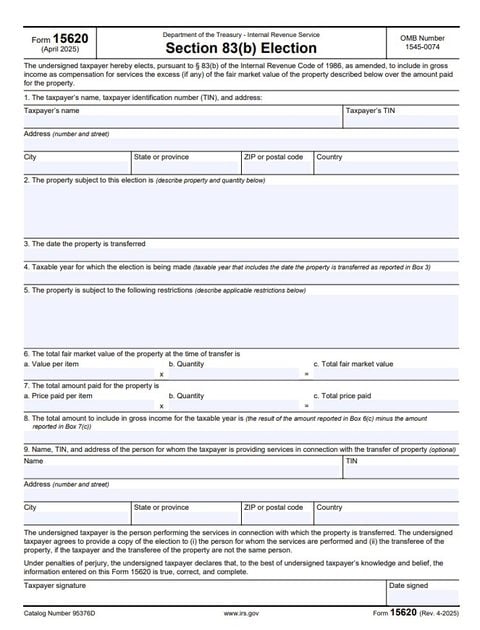
The process itself is fairly straightforward, especially since the IRS finally enabled online filing for 83(b) elections in 2025. Filers can complete and submit the election online through the mobile-friendly forms portal on IRS.gov using Form 15620. An online account with the IRS is required.
The form asks for certain key information, including:
- The personal details you'd expect, like your name, address and Social Security or taxpayer identification number.
- A description of the property awarded (number and type of shares of which company) along with the date received or purchased, any restrictions your shares are subject to and the fair market value of the shares on the date received or purchased.
- The amount paid for the company shares.
- The amount the employee will indicate as gross income on their income tax return.
Filing online is generally the easiest and preferred method. But if you can't or don't want to make the election online, you can mail the election form instead. Be sure to send your election form through certified mail with a return receipt in case you need to prove that it was sent by a particular date. (Online filing will provide a similar confirmation.)
Explore more on
Article sources
NerdWallet writers are subject matter authorities who use primary, trustworthy sources to inform their work, including peer-reviewed studies, government websites, academic research and interviews with industry experts. All content is fact-checked for accuracy, timeliness and relevance. You can learn more about NerdWallet's high standards for journalism by reading our editorial guidelines.
- 1.IRS.gov. Section 83(b) Election. Accessed Jun 29, 2026.
- 2.IRS.gov. Topic no. 409, Capital gains and losses. Accessed Jun 29, 2026.
- 3.National Association of Stock Plan Professionals. Understanding Early Exercise and 83(b) Elections. Accessed Jun 29, 2026.