




Updated on July 22.
The House this week passed a measure to extend funding the federal government through Dec. 4, in a bid to push a potentially bruising funding battle until after midterm elections. The measure has no chance in the Senate, experts surmise.
There are budget disagreements between and within both parties that make any agreement that could pass both houses of Congress (and be signed by the president). Absent a breakthrough, the government could very well shut down again on Oct. 1. Midterm elections are Nov. 3.
Last year saw the longest full government shutdown in U.S. history (Oct. 1 to Nov. 12, 43 days) while this year was marked by the longest partial shutdown ever (Feb. 14 to April 30, 76 days). And 2026 may have more to give.
Previous updates
April 30: A record-breaking partial government shutdown ended as the House passed a bill approved by the Senate weeks ago to fund most of the Department of Homeland Security (DHS).
The deal fully funds all DHS offices with the exceptions of Immigration and Customs Enforcement (ICE) and Border Patrol. Democrats supported the deal, despite it lacking any of the restrictions on the two agencies that they have been demanding throughout the shutdown.
Meet MoneyNerd, your weekly news decoder
So much news. So little time. NerdWallet's new weekly newsletter makes sense of the headlines that affect your wallet.
What happened during the DHS shutdown?
DHS funding became a flashpoint following the fatal shootings of Renée Good on Jan. 7 by an ICE agent and Alex Pretti on Jan. 24 by a CBP agent, both in Minneapolis. During funding negotiations, Senate Democratic Leader Chuck Schumer said Senate Democrats would not allow a DHS bill to advance without reform measures.
Shortly after midnight on Feb. 14, the Department of Homeland Security (DHS) shut down after lawmakers failed to reach a deal to reform ICE tactics. The DHS shutdown followed a four-day partial shutdown that ended Feb. 3.
Since most DHS functions are considered essential, including U.S. customs and Border Patrol, ICE enforcement, Transportation Security Administration (TSA), FEMA, the Secret Service and the Coast Guard, meaning those workers were expected to continue to report without pay. “Non-essential” support and administrative staff were furloughed.
Flights continued, but the prolonged shutdown has led to TSA staffing shortages — similar to those during fall 2025 full shutdown — causing long security lines, flight delays and cancellations.
On March 23, Trump deployed Immigration and Customs Enforcement (ICE) officers to several of the nation’s busiest airports to assist with TSA efforts. In late March and early April, Trump Trump directed the DHS to find a way to pay all DHS workers during the shutdown, but there were no plans to continue paying them until the shutdown ended.
Why did the government shut down in 2025?
Every year, Congress is supposed to pass 12 spending bills to keep the government’s lights on. These appropriations bills fund those programs already approved by Congress, including defense, the IRS, food assistance, veterans’ benefits and national parks.
The deadline to fund programs for the next fiscal year — in this case 2025-2026 — is always Oct. 1. Without passing appropriations bills or approving a stopgap that kicks the deadline down the road, the government shuts down.
Why didn’t Congress pass the funding bills? The two parties are deadlocked over Democrats’ demands to permanently extend expiring Obamacare subsidies and roll back recent Medicaid cuts in the One Big, Beautiful Bill Act (OBBBA).
In the past few funding cycles, Congress has relied on multiple short-term continuing resolutions to keep the government temporarily running.
What happened when the government shut down?
On Nov. 5, the U.S. government shutdown became the longest in history. Up until that point, the longest-ever shutdown lasted 35 days. The shutdown inflicted a slew of hardships on federal workers, social benefits recipients and travelers:
- Many thousands of federal workers were put on furlough while all other essential staff continued to report without pay. In the shutdown’s third week, most federal workers received partial paychecks for work through Sept. 30.
- Thousands of flights were canceled after the shutdown began. On Nov. 7, air traffic in 40 “high traffic” markets was reduced by 10% as many air traffic controllers and TSA agents, forced to work without pay, called out sick. Safety concerns were cited as the reason for the reduction.
- Certain benefit programs, financial aid disbursements and IRS verifications were delayed.
- Federal courts across the country ran out of funds, forcing them closed or running with limited operations. The Supreme Court remained open, but the building was closed to the public.
SNAP funding had been set to halt on Nov. 1. But following rulings in two federal court cases, the White House agreed to partially fund SNAP, cutting payments to participants in half.
How did the 2025 shutdown end?
Trump signed a spending package on Nov. 12, ending the longest-ever government shutdown.
The House of Representatives came back to the Capitol after a seven-week recess to pass a package of measures to end the shutdown on its 43rd day.
The House passed the measures with a 222-209 vote on Nov. 12, largely along party lines. The Senate approved the package on Nov. 10 after enough Democrats crossed the aisle to give Republicans the 60 votes needed to pass the “minibus” package.
The minibus also included three bills that fund military construction, the Department of Veterans of Affairs, the Department of Agriculture and the Food and Drug Administration (FDA) and legislative branch operations. The package fully funds Supplemental Nutrition Assistance Program (SNAP), a government program that provides food benefits to low-income Americans, through September 2026.
The package also included a provision to rehire government employees laid off during the shutdown. Soon after the shutdown began, the White House sent notices to at least 4,100 workers in seven departments. Days later, however, a federal judge temporarily blocked the layoffs. The bill ensured the workers are not only rehired, but also receive backpay. In addition, the bill prohibits any other mass layoffs of federal workers through Jan. 30.
Since the previous shutdown began on Oct. 1, the Senate had voted on — and failed to pass — a GOP-backed funding stopgap to end the shutdown 14 times. Throughout the shutdown, Democrats sought concessions on health care spending.
Democrats didn’t receive their biggest demand: extended health care subsidies and rollbacks to cuts to Medicaid and Medicare that were included in the OBBBA. But there was one key inclusion in the package: a vote on Democrats’ Affordable Care Act Bill. In December, four Republicans split with their party to join Democrats to back a discharge petition on a bill to extend ACA subsidies for three years. On Jan. 8, the bill passed the House and is now with the Senate.
How long did the 2025 government shutdown last?
At 43 days, the government shutdown was the longest in history. There have been 22 shutdowns since 1976 and most are short-lived — a few hours or days, at the most.
There hasn’t been a shutdown since the 2018-2019 shutdown, which lasted 35 days. The reason for that shutdown was a dispute over funding for Trump’s border wall in his first term.
Before that there was a 16-day shutdown in 2013 as negotiations over the Affordable Care Act dragged on. In 1995 and 1996, two shutdowns totaled 26 days.
What happens when the government shuts down?
Federal workers bear the brunt of impact from government shutdowns.
During a shutdown, there are ripple effects on delivery of government services and programs.
What’s affected immediately:
- National parks may close or operate without services.
- Federal student aid application processing could be delayed. The shutdown coincides with the opening of the Free Application for Federal Student Aid (FAFSA).
- Food and drug inspections will be delayed.
- The IRS can’t verify income and Social Security numbers, which could cause delays for some mortgages and other loan approvals, as well as tax refunds.
What will keep running, to a point:
- Flights will still operate, but there could be delays if TSA agents and air traffic controllers, who are considered essential employees, decide to call out of work, leading to staff shortages. Even small shortages can have a big impact: During a 2019 government shutdown, the absence of just 10 air traffic controllers at two airports grounded flights and caused delays for the Eastern Seaboard. (Read more on how the shutdown affects travel.)
- Social Security and Medicare will keep going, but some administrative functions may be suspended, and telehealth appointments may be interrupted.
- Unemployment benefits will continue — states administer compensation — but there could be application processing delays if the shutdown lasts long enough.
- Food benefits through Supplemental Nutrition Assistance Program (SNAP) and the accompanying WIC program will continue — both run on contingency funds. WIC funding will only last one month, and SNAP could be strained after 30 days, as well.
What won’t be affected:
- The postal service — the USPS is not funded by the federal government.
- Federal student loan payments — accounts are serviced by private companies.
- Public schools will remain open — they’re funded by state and local governments.
- Amtrak will continue operations — it is operated by a for-profit company.
However, if a shutdown happens after Jan. 30, it would not impact services — like SNAP — that were fully funded through Sept. 30 by the continuing resolution.
See more details on how a government shutdown could impact you.The shutdown has had trickle-down economic effects. One immediate and direct impact during the previous shutdown was a suspension of federal economic data. Most of that data wasn’t released during the shutdown. That’s a problem because the government’s official data releases guide the markets, the Federal Reserve and business decisions.
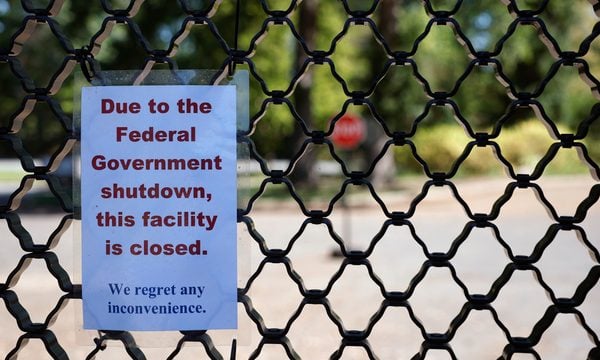
(Photo by Stephen Maturen/Getty Images News via Getty Images)